
In this post
I have spent more than twenty years in media and sales. In that time the way brands become visible has changed several times. First there were newspapers and television, then search engines, then social media. Each era had its own rules, but the question was always the same: when a customer has a need, do they think of you?
Today that question has moved somewhere new. People no longer type "which CRM is good for a small business in Istanbul?" or "what is the best accounting software for small companies?" only into Google. They ask ChatGPT, Gemini, Claude and Perplexity. Instead of ten blue links they get a single answer. If your name isn't in that answer, you don't exist for that customer.
Building GeoDog gave me the chance to study this closely. In this post I explain how I measure a brand's place in AI answers, and what actually moves it.
What is GEO?
GEO, Generative Engine Optimization, is the work of increasing the likelihood that a brand or a piece of content is mentioned, recommended and cited as a source in the answers of generative AI. The term spread with a paper by Aggarwal and colleagues, published at the end of 2023 and accepted at KDD 2024. The researchers built a large query benchmark called GEO-bench and showed that certain changes to content can boost a source's visibility in generative engine responses by up to 40%. Citing sources, adding quotations and including concrete statistics were among the strongest methods. The paper makes another important point: the effect varies from domain to domain. There is no single recipe that fits everyone.
Is SEO dead?
No. I hear this question a lot and my answer is clear: GEO doesn't replace SEO, it builds on top of it. Many AI assistants search the web while answering and read the pages they find. A page that can't be crawled, loads slowly or is vague about what it offers never makes it into those results in the first place.
The difference is this:
- SEO moves your page up the list of links. What you measure is ranking and clicks.
- GEO aims for your brand to be named inside the answer. What you measure is mentions, recommendations, accuracy and which sources the answer relies on.
Both share the same foundation: a technically sound site and content that is genuinely useful. But GEO goes one step further and accounts for sources outside your control. The AI knows you not only from your own site, but from everything written about you.
Why is it hard to measure?
Measuring rankings in Google was relatively easy. You type a keyword and check your position. AI answers are different:
- Answers vary. Ask the same question twice and you may get two different answers. Deciding on the basis of a single try is misleading.
- Models differ. The brand ChatGPT recommends may not be the one Perplexity recommends. Each model has its own sources and habits.
- Same names get mixed up. If your brand shares its name with another company, a city or a common word, the model may be talking about that instead of you. A score that doesn't filter this out is meaningless.
- The question set decides the result. Which questions you ask shapes what you see. Look only at questions that contain your brand name and you will think you're doing better than you are.
How I measure it
I build the measurement on two kinds of questions.
Branded questions contain the brand name. "What is Rocketly CRM?", "How much does Rocketly CRM cost?" Here I look at accuracy: does the model know me correctly, does it give the right facts, or does it make things up?
Discovery questions don't contain the brand name. They are the questions a real customer would ask: "Can you recommend a CRM with WhatsApp integration in Turkey?" These are the ones that matter most, because a customer who doesn't know you yet will find you through exactly these questions.
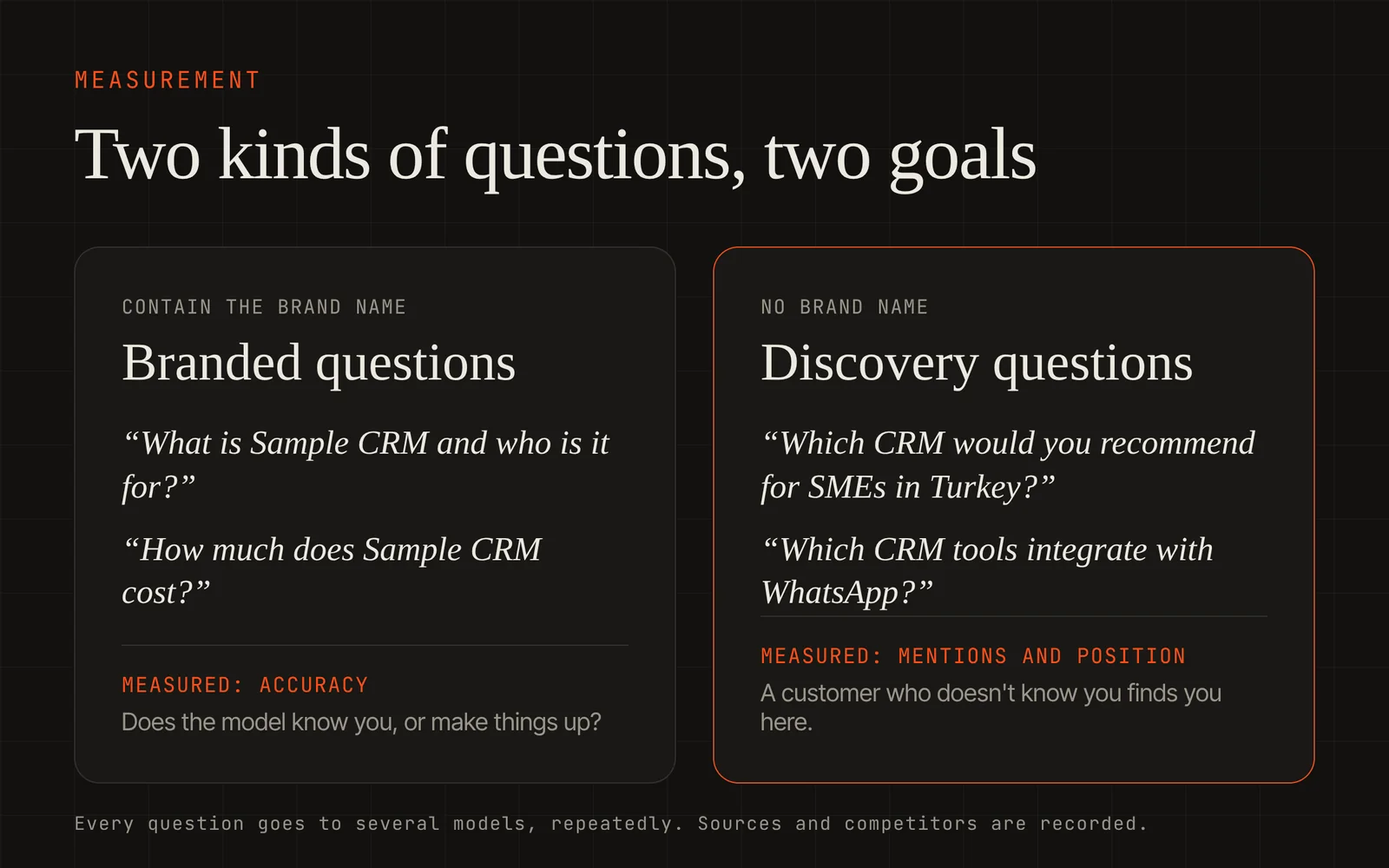
I ask every question to more than one model and record, for every answer:
- Was the brand mentioned?
- If so, was it recommended, and in what position?
- Was the information correct?
- Which sources did the answer rely on?
- Which competitors were mentioned?
Then I put it in a table next to the competitors. Same question set, same models, same period. Only that kind of comparison means anything.
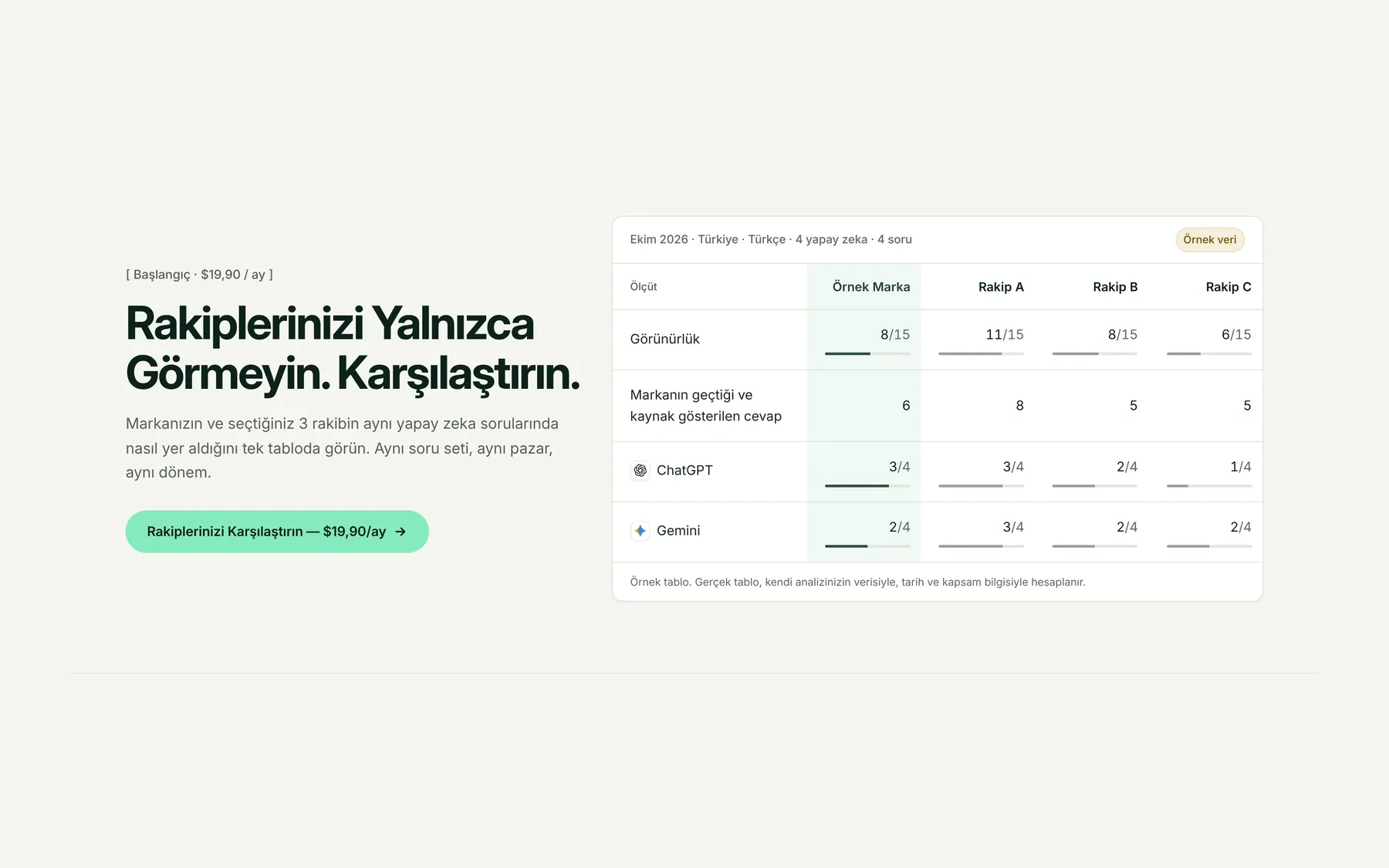
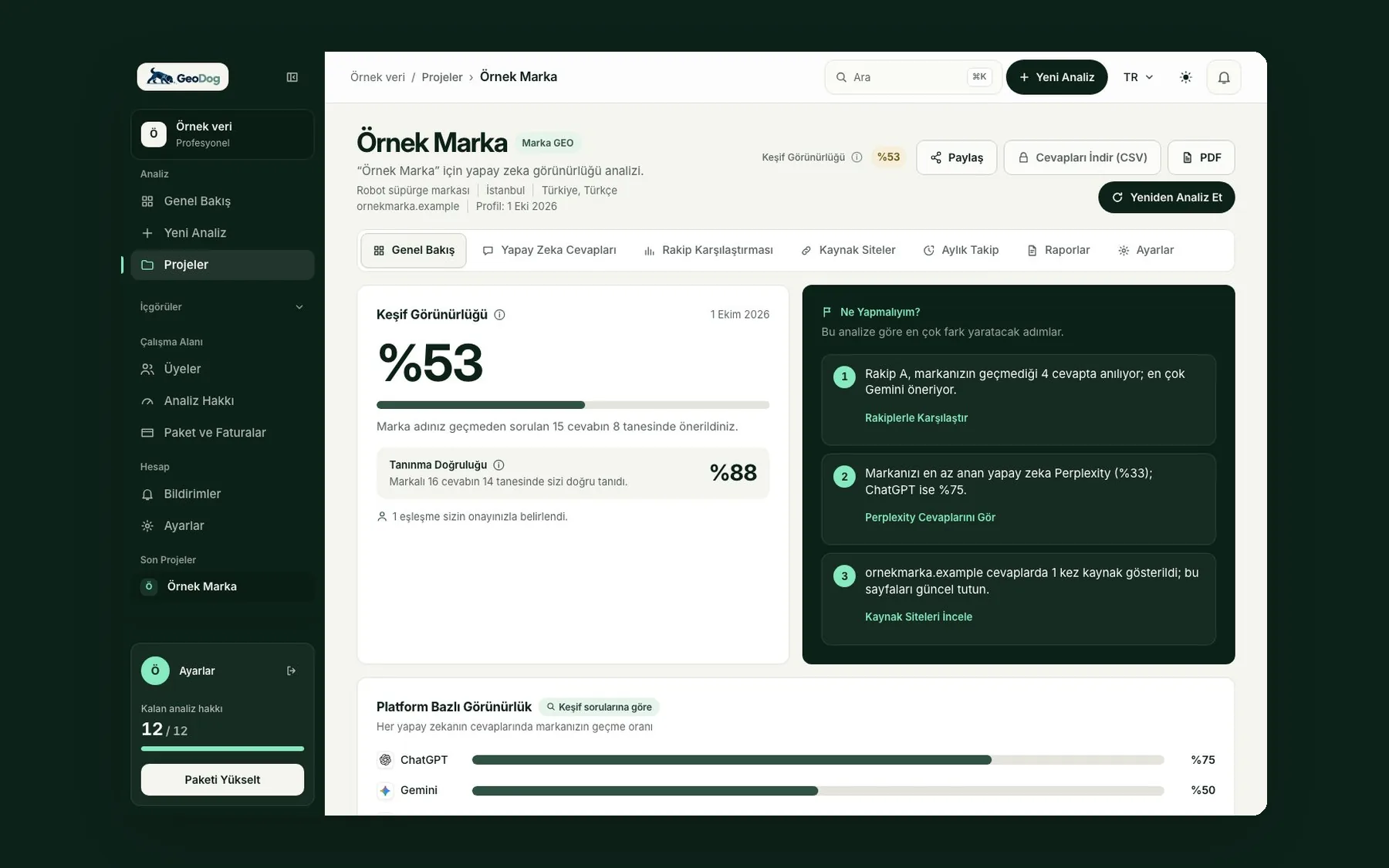
You can do this by hand, but it is tiring. I built GeoDog precisely to automate it. You enter the brand name, the website and a few keywords; the system builds a brand profile, asks four AI models four branded and four discovery questions, removes wrong same-name matches from the score and shows the results together with their sources. You can review and change the questions before any credit is spent, and every month the same measurement runs again so you can follow the trend.
To make it concrete, here is the question set I would build for a fictional CRM brand selling to small businesses in Turkey:
Branded
1. What is Sample CRM and who is it for?
2. How much does Sample CRM cost?
3. Which channels does Sample CRM integrate with?
4. Is Sample CRM reliable, and what do users say about it?

Discovery
5. Which CRM would you recommend for small businesses in Turkey?
6. Which CRM tools have a WhatsApp integration?
7. What is the best CRM with a Turkish interface for a sales team?
8. What should a company moving from Excel to a CRM choose?
When I read the results I don't fixate on a single score. First I check accuracy on the branded questions; if a model quotes a wrong price or a feature that doesn't exist, the first job is to find where that information came from. Then I look at the mention rate and position on the discovery questions. Last comes the source list: which sites mention the competitor but not me? The most valuable insight usually comes from that final step.
My most important advice: don't measure once and stop. Models are updated constantly and competitors move. Without monthly tracking you never really know what is working.
What needs improving?
Measurement tells you where you stand. The next question is how to change it. Five areas make the difference in practice.
1. Open the door
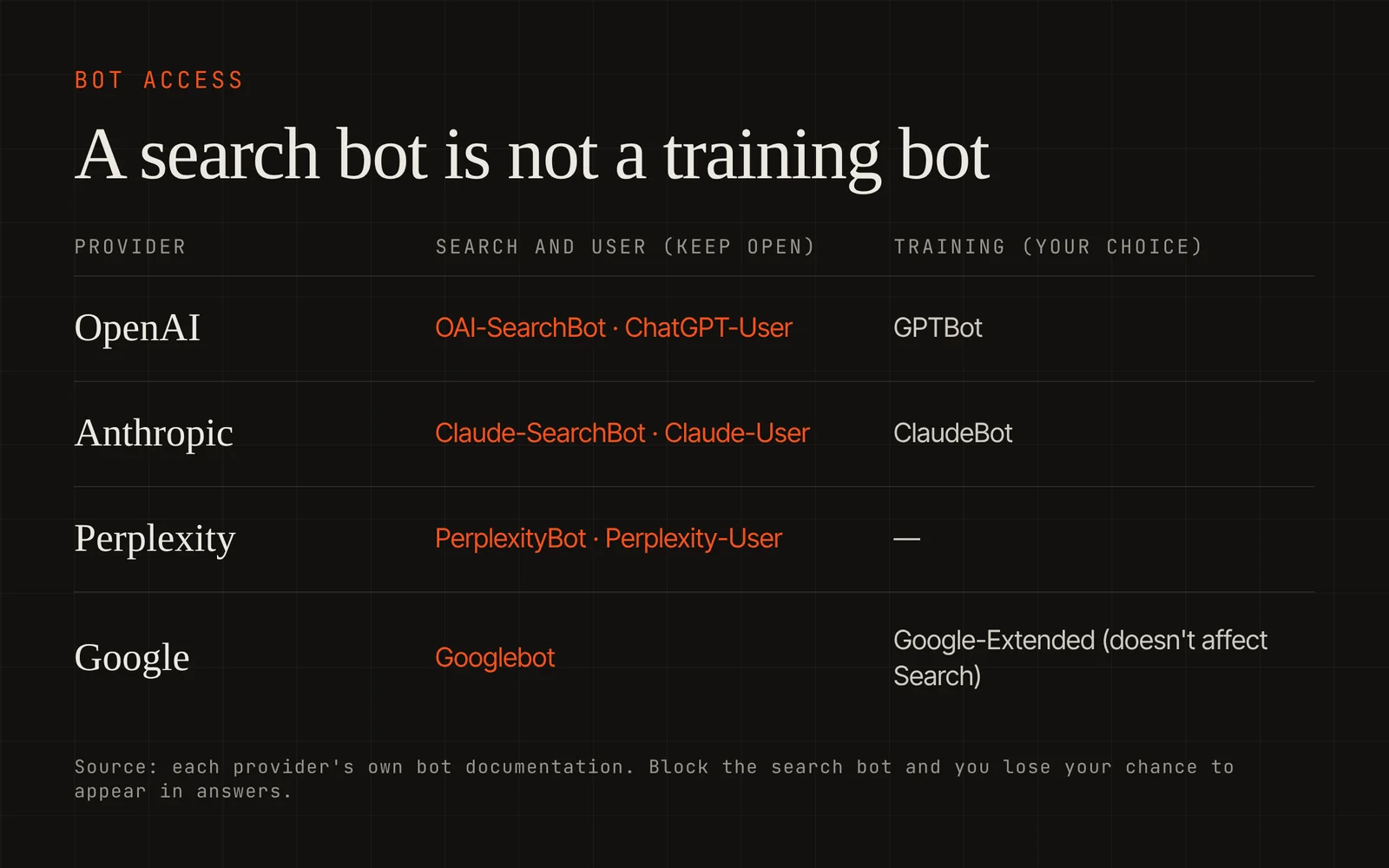
The first check is the simplest, yet a surprising number of sites fail it: can AI bots read your site? Each provider runs different bots for different purposes. OpenAI's OAI-SearchBot is used to surface websites in ChatGPT's search features, and according to OpenAI, sites that opt out of it will not be shown in ChatGPT search answers. Anthropic's Claude-SearchBot and Perplexity's PerplexityBot also work for search results.
One distinction matters here: a training bot is not the same as a search bot. If you don't want to contribute to model training you can block GPTBot or ClaudeBot, but if you block the search bots you also give up your chance to appear in answers. Google has a similar split: according to Google, blocking Google-Extended does not affect a site's inclusion in Google Search.
The robots.txt I use on this site looks roughly like this:
User-Agent: *
Allow: /
Disallow: /api/

User-Agent: OAI-SearchBot
User-Agent: ChatGPT-User
User-Agent: Claude-SearchBot
User-Agent: Claude-User
User-Agent: PerplexityBot
User-Agent: Perplexity-User
Allow: /

Sitemap: https://noyankalay.com/sitemap.xml
Check your firewall too. Some CDN and security settings quietly block clients they don't recognise. Test bot access with real requests, not just by reading robots.txt.
2. Make it clear who you are
AI recognises you as an "entity": your name, what you do, where you are, who founded you, who you serve. If these facts read differently in different places, the model draws a confused picture.
The steps are simple but take discipline. Write your brand name the same way everywhere. Use the same short description on your site, on LinkedIn, on your Google Business profile and in directories. Add schema.org structured data to your site: Organization, Person, Product or Service, with sameAs links to your official profiles. That makes it easier for a model to conclude "this brand is the same thing as this site, this person and these profiles".
3. Create content worth citing
When a model builds an answer it looks for clear, verifiable information it can quote. "The industry's leading solution" says nothing. "Brings WhatsApp, Instagram and email into one inbox, in Turkish and English" says something.
Content that works:
- Pages that answer a question directly. The heading is the question, the first paragraph is the answer.
- Concrete numbers: price ranges, setup time, supported integrations.
- Comparisons: pages that honestly answer "what is the difference between X and Y?"
- FAQs built from questions real customers actually ask.
- Sources. If you make a claim, show what it rests on.
4. Get others to talk about you
This is where GEO differs most from SEO. Look at the sources cited in AI answers and you will see that most of them are not the brand's own site: comparison articles, list posts, review sites, industry publications, forums.
That is why the source list is the most valuable data in a measurement. Which sites do the models read in your category? If you're on them, your chances go up. If you're not, look for a way in: be included in a comparison piece, collect genuine customer reviews, give an expert comment to an industry outlet. There is no shortcut here, and there shouldn't be.
5. Keep the technical foundation solid
Fast pages, content rendered on the server and a clean sitemap make every bot's job easier. I use IndexNow to notify Bing of new pages quickly. Then there is llms.txt, a file that summarises your site for language models, proposed by Jeremy Howard in 2024. To be honest, there is no clear evidence that the big providers officially use it in their search products. Still, it costs almost nothing and helps agents understand your site, so I add it.
What not to do
As with every new channel, some people look for shortcuts. Stay away from these:
- Keyword stuffing. AI notices it, and the GEO paper found it doesn't work.
- Fake reviews and made-up lists. Even if they win something in the short term, they damage your brand and your credibility.
- Content written only for AI. Pages nobody would read, aimed only at bots, lead nowhere in the long run.
- Deciding on a single measurement. Answers vary. Measure repeatedly and regularly.
You can't manage what you don't measure
The most basic rule I learned in media is this: you can't manage what you don't measure. It was true for ad spend and for sales funnels, and it is true for AI visibility.
Today many brands are flying blind here. Either they don't look at all, or they occasionally type their name into ChatGPT and decide based on whatever comes back. But when you measure with the right question set, across several models, side by side with competitors and every month, the picture becomes clear. You see what works, which sources carry you and where a competitor gets ahead of you.
The good news is that this field is still new. The brands that act today will be the names that come to mind first in their category tomorrow. If you're curious where your brand stands, you can run an analysis with GeoDog or simply write to me.